
I’ve dipped my sneaker in the Mississippi. I was almost nine and my mother, brother, and I were on a month-long Greyhound bus trip across the United States. We stopped in Memphis, Tennessee so we could see the mighty river. I remember a lot of cobblestones leading down to the water and my blue denim shoe nudging a bit of mud. Having grown up a stone’s throw from the Atlantic Ocean, it didn’t really look all that impressive, but we must’ve had to learn how to spell it for a reason, right?
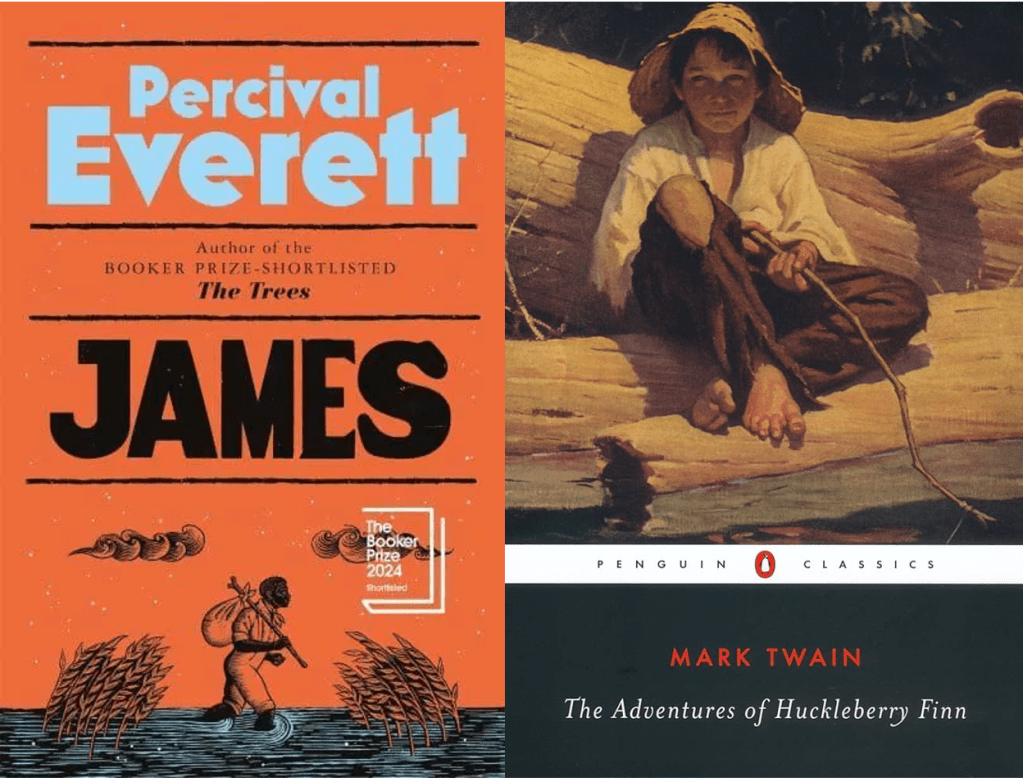
As with many kids my age, it was Mark Twain who showed me that a river was more than a muddy shoe. I first read The Adventures of Huckleberry Finn in school – which tarnished its appeal – but the romantic idea of floating away from home definitely stuck. When I read it again about a decade later, Huck’s humanity rose to the surface as he wrestled with society’s view of right and wrong vs. his own. “All right, then, I’ll GO to hell,” he says to himself after deciding to protect the runaway slave and his raft companion, Jim.
It was Jim who got me to read Twain’s controversial classic a third time. Or, more accurately, it was a man who imagined Jim’s point of view, the author Percival Everett. I’d recently seen the movie American Fiction, adapted from Everett’s novel, Erasure. The main character’s exasperated view of American society—a viewpoint I could appreciate but never fully comprehend as a white person of European descent—made me deeply curious to read Everett’s words firsthand.
Everett has written over thirty books, been nominated for many awards, and his most recent novel James follows many of the twists and turns of Twain’s Huckleberry Finn. Huck has staged his own death near a small Missouri town to escape his abusive father. James, or Jim as most know him, walks and then swims away from the town when he learns that he’s to be sold ‘down river’ far from his family. When the two meet on an island in the Mississippi, they each see advantages in travelling the river together. That they navigate it differently, however, is increasingly clear. To Huck, the river is an adventure filled with entertainment. To James, it’s an escape route filled with menace.
It’s not giving anything away to reveal that only around white people does James use a “Missouri negro dialect” as Twain described it. It pointedly shows how most if not all the white characters see the slaves vs. how these slaves see and speak themselves. Language, names, words are important to Everett and if they disconcert the reader in various ways, I’m willing to accept the discomfort.
And this novel is discomforting, especially compared to Twain’s novel. This isn’t the perspective of a young boy or the famous humorist who created him, it’s mid-19th century America seen through the eyes of a man who may have seen his wife and daughter for the last time, who’s desire to write leads to the death of a new friend, who is powerless to protect a woman from an overseer’s lust.
These moments and emotions will linger long with me, but I also appreciated that Everett has taken a page from Twain’s comedic way of seeing the world. After James is bitten by a rattlesnake, he dreams he’s arguing with a French philosopher, when he and Huck get stuck traveling with two hucksters, he listens with amusement as one performs a Shakespearean soliloquy that tricks a town out of most of its cash, and pretty much all the conversations he has with fellow slaves are tinged with a dark humor that keeps them going.
Everett’s telling was so engrossing that I wanted the novel to keep going, so much so that a few chapters from the end I put it down and picked up The Adventures of Huckleberry Finn for a third time. It had been decades. And this time I saw it, as much as I could, through James’ eyes. Huck’s quick wit to get himself and Jim out of trouble is wildly entertaining, and Huck is clearly increasingly fond of Jim. But he also overshadows him; Jim seems stunted by the words Twain gives him and by Huck’s well-meaning but poor-sighted judgements. “I do believe he cared just as much for his people as white folks does for their’n,” observes Huck about Jim. “It don’t seem natural, but I reckon it’s so.”
Reckoning goes much deeper in James, whether because what’s at stake is as clear as it is dangerous or that James is a grown and educated man, a man who recognizes the value of learning and books. “At that moment the power of reading made itself clear and real to me,” he observes, while Huck sleeps. “If I could see the words, then no one could control them or what I got from them.”
What you get from James and The Adventures of Huckleberry Finn is a bit like the Mississippi. Dip your toe in the water and you’ll see one thing. Get on a raft and every bend in the river shows you more of America, where we’ve been and where we might be going. Who should read these books? It’s wishful thinking, but I’ll echo the novelist, Ann Patchett: “Every person in the country.”
Where to get these books? At your local library, online, or, if you’d like to support small businesses, at a local bookstore. Here are a few favorites near me… WHERE TO BUY, BORROW, & READ BOOKS IN THE CATSKILLS
Originally published in the Sullivan County Democrat, 11/1/24

 Reading In the Catskills